April 3, 2008
Edited by Charla Borchers Leon,
Victoria County Master Gardener
But before you can entice them into your own yard, you need to understand their life cycle which exists in 4 complex stages. In the first stage the female butterfly will lay an egg. Secondly, a caterpillar will emerge; thirdly, it will change itself into a chrysalis (or transformation stage), and finally in the fourth stage it emerges as a full-grown butterfly.
The female butterfly not only lays her eggs on plants, but she is very specific as to on which plant she will do so. This very specific plant then becomes a larval or host plant for that butterfly. Some plants serve as not only a food source for the caterpillar but also as a nectar source for the mature butterfly.
When the egg hatches, the ensuing caterpillar will eat the leaves of this host plant until it reaches
a mature stage. It will shed its skin several times before forming a chrysalis which with time will develop into a butterfly. The developed butterfly will need plenty of food, and that will be in the form of nectar which is its only form of nourishment. Plant plenty of flowers in sunny locations to provide nectar. Keep in mind that butterflies begin their day by sun bathing to warm their bodies to become active. Warmer temperatures not only warm the butterflies but nectar will also start to flow more freely in sunny areas thus providing ample food for the butterflies.
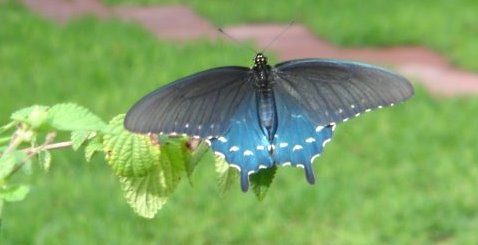
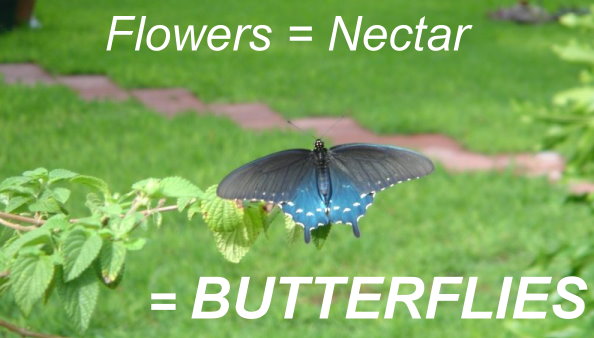
Simply put: Flowers = nectar = butterflies.
If you want to go a step further and have them reproduce in your yard, then you will have to provide larval plants for the female butterfly to lay her eggs on. The problem arises that this will produce hungry caterpillars that will eat your plants. Sometimes the caterpillars eat the young to mid-mature leaves, sometimes the entire above ground portions of a plant and sometimes the buds, flowers or young fruit. Obviously, some people may not want caterpillars in their yards.
As you look over the printed list of larval plants you will notice that thistle is mentioned as the host plant for a few butterflies. Most people would prefer not to have nettles or thistles in their yard but by planting behind other plants or in the back corner of your yard, you can still provide the red admiral and painted lady with the plants they need.
Butterfly Species Food plant for its caterpillar stage
Black Swallowtail Dill, parsley anise, fennel, carrots, rue
Buckeye Plantain, snapdragon
Cloudless sulphur Senna, partridge pea
Giant Swallowtail Citrus trees, rue
Giant purple hairstreak Mistletoe
Goatweed butterfly Goatweed (Croton ssp.)
Gray hairstreak Various legumes, (including Esperanza)
Gulf fritillary Passion flower vines
Hackberry butterfly Hackberry
Little sulphur Partridge pea
Monarch Milkweeds
Painted lady Hollyhock, thistles
Pearl crescent Aster
Phaon crescent Texas Frog Fruit (considered a weed)
Pipevine swallowtail Dutchman’s Pipevine (all species of Aristolochia)
Queen Milkweeds
Question mark Hackberry, elm
Red admiral Nettles, false nettle
Snout butterfly Hackberry
Sulphur butterflies Lindheimer senna
Tawny emperor Hackberry
Texan crescent Shrimp plant, ruellia
Tiger Swallowtail Ash, Common catalpa, spicebush
Zebra longwing Passion flower vines
Viceroy Cottonwood, poplar, willow
Source:
Victoria County Master Gardener Linda D. Valdez
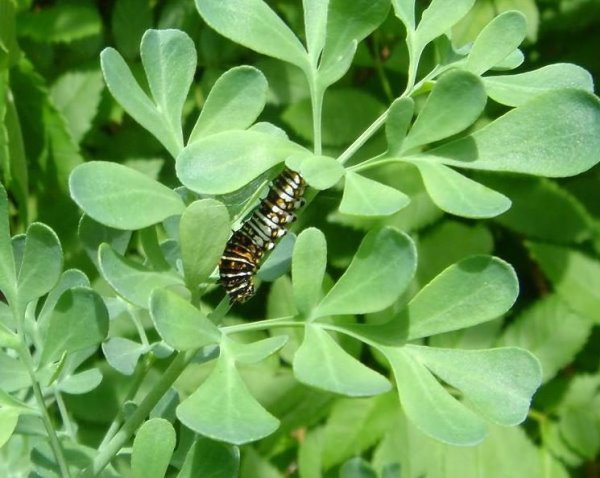
The black swallowtail caterpillar feeds on herbal plants including dill, parsley, fennel and rue that is shown here.
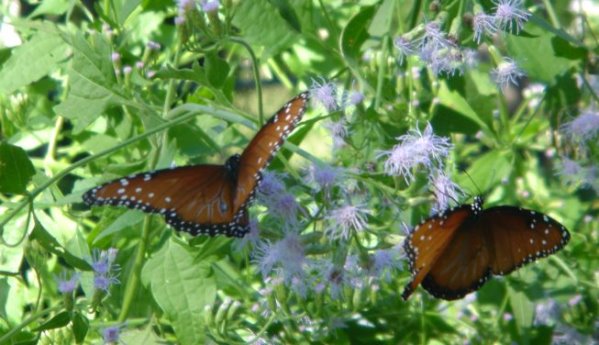
Butterfly bush (Buddleia davidii) requiring good drainage comes in several colors and can become a big bush. The milkweeds of which there are over 108 different types in the United States are not only good nectar plants, but are also host plants for the queen and monarch butterflies. Two Eupatorium plant species that are excellent in attracting butterflies are crucitas (E. ordoratum) and blue mist flower (E. gregii) both producing blue mist type flowers. The crucitas, a superb nectaring plant, should be planted in a large sunny area. It can easily get to be 6’X6’ in size. I planted it in my yard and in the fall when it bloomed, I counted over 15 species of butterflies on it in one day. Blue mist flowers should be planted in an enclosed bed because it spreads readily. If you have limited gardening space check carefully on the plants you wish to plant because many nectaring and larval plants can get quite large. A prime example is purple porter weed which can get very tall. If you don’t have the space look for the dwarf porter weed variety.
Plant the herbs listed in the printed table for the black swallowtail to lay her eggs. In my yard she tends to favor the dill herb. With both species of milkweed planted in my yard, I have many queen and monarch butterflies. Sometimes I will see both of them nectaring on blue mist flower (E. gregii). If you are looking to entice the Gulf fritillary, plant the purple Passiflora incarnate or the native yellow passion vine, Passiflora lutea. These grow beautifully on fences or on a trellis. However, there are several beautiful cultivars to be wary of. If the female lays her eggs on them they will not come to fruition.
Common Name Flower Color
Asters Pink, purple, lavender, white
Butterfly Bush Purple, lavender, white, yellow
Butterfly Weed Yellow
Button Bush Cream
Blue Mist flowers Lavender
Purple Cone Flower Dark pink
Cosmos Yellow, orange
Crucitas Blue
Duranta Purple, white, light blue
Flame bush Red-orange
Goldenrod Yellow
Jatropha Red, pink
Lantana Yellow, orange
Mexican flame-vine Orange
Mexican heather Lavender
Mexican milkweed Red-orange and yellow
Mexican sunflower Orange
Mist flower Blue
Pentas Red, pink, lavender, white
Phlox Purple, pink, red, white
Porter Weed Purple, coral, red
Salvia Lavender, pink, red
Verbena Purple, lavender, blue, red, pink, white
Zinnia Yellow, orange, red, pink, white.
Butterflies will often puddle together at a moist area. They are not drinking water but seeking the salts or amino acids left behind. You can make your own puddling station by filling a plastic saucer with sand and salt. In her book Butterfly Gardening for the South, author Geyata Ajilvsgi suggests a ratio of ½ to ¾ cup of salt to one gallon of moist sand. Be sure to keep the mixture moist.
After you have chosen plants for your yard, be sure and mulch them and keep them watered. Then sit back and enjoy an abundance of butterflies visiting your yard.