


DRIED FLOWERS
Save your summer beauties now for tomorrow’s enjoyment
August 07, 2008
By Barb Henry, Victoria County Master Gardener
Edited by Charla Borchers Leon, Victoria County Master Gardener
Silica gel drying involves burying flowers in gel granules to preserve the shape of the flower in shallow, air tight containers. Once the granules are pink from moisture, they can be oven dried on a cookie sheet at 250 degrees for future use.

It is time to save summer blooms to enjoy through the fall and winter. With a little care, dried arrangements can last for a year or more. Ever popular in country décor, dried flowers can enhance any home’s style. Dried flowers can also be used in wreaths, swags, bouquets, pressed flower pictures, in potpourri, on hats and lampshades. Blend them beautifully with silk flowers. Several techniques are simple and cost effective.
AIR DRYING
By far the simplest and least expensive technique, air drying, is suitable for most varieties. Experiment. Some flowers may lose their color; others their petals. Hang small bunches upside down in a dim, airy place to keep stems straight, otherwise the heavy heads may droop, and the finished product will be distorted.
Remove lower leaves, bind stems together well, as they will shrink as they dry. Rubber bands work well and contract as stems dry, but twine or wire can be used also. Paper clips slipped onto the rubber bands work well to hang each bunch of stems on a line strung high and out of the way. Wall racks and hooks work, too.
In our Coastal Bend humidity, hanging them in an air-conditioned room or airy closet yields good results. A garage, attic or shed can be used if it’s dry and dust-free. Generally, it takes about two to three weeks to dry properly.
Some plants with light-weight flowers (like Baby’s breath) or firm woody stems (like hydrangea) do not require hanging. Just set loosely in a jar or vase and allow to dry in a dark, airy place.
If drying only flower heads, spread newspaper or cloth on a table, floor, screen or wire rack. Flower heads should be wired before drying to make handling finished flowers easier. Later, you will add stronger wire for a stem, and wrap all with green floral tape. Stick a fine floral wire into the stem base of the flower coming out through the top.
Make a small hook in the wire, and gently pull the hook back down until it is hidden in the flower center. Have extra flowers on hand to allow for breakage or damage.
SILICA GEL DRYING
The technique of silica gel drying involves carefully burying flowers in gel granules to preserve the shape of the flower. Silica gel is not cheap, but is reusable almost indefinitely if dried between uses. It can be bought at most craft, floral, photo and electrical stores. Some gel is white, but it also comes in clear blue crystals that turn pink as the gel absorbs moisture.
Use shallow containers to make maximum use of the drying material. The natural stem can be removed before drying. Keep any broken flowers or dropped petals for potpourri.
Place flat-faced flowers face down in gel. Other more full-petalled flowers usually work better face up, then gently sprinkle gel until totally covered.
While drying, the containers must have airtight lids or the gel will absorb moisture from the air, and flowers will dry too slowly or not at all. Seal loose tops with tape to make air-tight.
When the gel is all pink, oven-dry it for reuse. Spread it evenly about a half an inch thick on cookie sheets. Bake in a 250-degree oven – until the crystals are blue again, stirring several times while heating. Store silica gel in airtight containers.
Other drying mediums besides gel can be used, like clean builders sand or white cornmeal, but unlike silica gel, leave these containers open for maximum air drying.

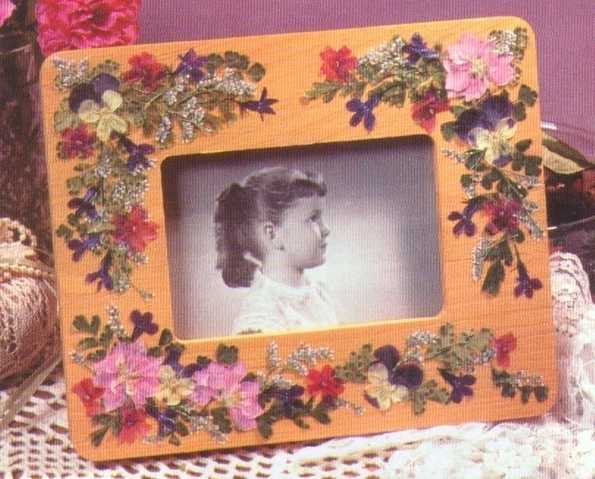
Pressing is an old technique of flower preservation that is easy, but the contour of the flower is lost with flattened results. This is perfect for decorating stationary, bookmarks, making flower pictures, scrap booking, etc. Use flat-faced flowers and foliage for best results.
Space flowers between several sheets of unglazed absorbent paper. Weigh down with a heavy object. Drying takes from two to four weeks, but check after one week. If pressing between the pages of a book, protect pages from discoloration with waxed or parchment paper.
GLYCERIN PRESERVING
Preserving in glycerin leaves specimens supple, not crisp. Colors usually fade to a tan shade, unless a dye is added to the glycerin. Remove lower leaves, cut stems on an angle and place in a jar with four inches of glycerin and color added as desired.
Leave in a dark, cool place for six to 10 days. Beads of glycerin will form on the upper ends of the plants when done. Wash the plant gently and pat dry.
Glycerin is available at most drug stores.
GENERAL GUIDELINES
Collect flowers early in the day, after dew has dried. Choose new blooms that are fresh and not yet fully mature. They should be flawless, as any damage will be amplified by drying. Remove them from the sunlight as soon as possible. This, and drying away from light, is important in maintaining good color. Subsequent fading may happen with exposure to light and moisture.
Drying time depends on humidity, temperature, airflow and the type of flower you are drying. Some flowers can dry in 24 hours. The flower is ready when it is stiff and dry, like paper.
Ferns, herbs, leaves, grasses, many seed pods and some fruits dry well, also. Use your imagination, experiment and have fun.
For an extensive list of flowers suitable for each method of drying see the University of Missouri Extension Web site at http://extension.missouri.edu/xplor/agguides/hort/g06540.htm
Microwave drying hints are available at http://www.ext.vt.edu/departments/envirohort/articles/misc/dryflwrs.html
For more Web sites on this subject do an Internet search for “drying flowers,” and you will find enough information to last you until next season’s flowers.
PLANTS FOR AIR DRYING
African marigold
Baby’s breath
Bachelor’s button
Cockscomb
Cornflower
Delphinium, larkspur
Globe thistle
Globe amaranth
Larkspur
Lavender
Marjoram
Pompon dahlias
Poppy
Roses
Scarlet sage and blue sage
Starflower
Statice
Strawflower
Yarrow (yellow
varieties best)
Bay leaves
Chives
Feverfew
Lavender
Mint
Rosemary
Rue
Sage
Sweet marjoram
Thyme
GRASSES
Bristly foxtail
Eulalia grass
Fountain grass
Hare’s-tail grass
Northern sea oats
Pampas grass
Plume grass
Quaking grass
Spike grass
Squirrel-tail grass
Cat-tail
Dock
Honesty (money plant)
Iris
Lily
Lotus
Milkweed
Mullein
Poppy
Queen Anne’s lace
Alyssum
Anemone
Azalea
Bleeding heart
Buttercup
Butterfly weed
Candytuft
Celosia, cockscomb
Chrysanthemum
Columbine
Cornflower, bachelor’s
buttons
Cosmos
Crocus
Daffodil
Daisy
Delphinium
Dutchman’s breeches
Geranium
Heath
Heather
Hydrangea
Johnny-jump-up
Larkspur
Lily-of-the-valley
Marigold
Nemesia
Pansy
Phlox
Primula
Queen Anne’s lace
Rose
Salvia
Statice
Sweet pea
Verbena
Zinnia
Topics:
Xeriscape gardening – Monica Pilat, Victoria County Master Gardener
Composting/ mulching – Roy Cook, Victoria County Master Gardener
Last class of the year
When: Monday
Time: Noon – 1 p.m.
Cost: Free to the public
Bring your lunch and drink
Where: Dr. Pattie Dodson Public Health Center, 2805 N. Navarro St., Victoria
Coordinated by Texas AgriLife Extension Service – Victoria County