
Good any way you slice it
You can harvest sweet cantaloupes by growing at home
May 6, 2011
by Roy Cook, Victoria County Master Gardener
edited by Charla Borchers Leon,
Victoria County Master Gardener


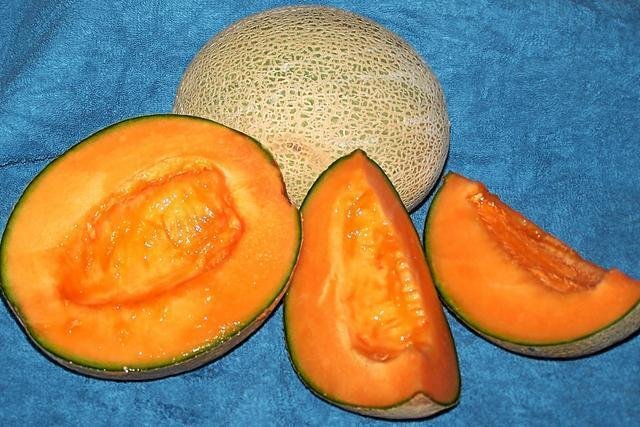
Cantaloupe - Ripe, Ready to Eat. "Even though available in grocery stores, growing your own cantaloupe allows you to not only try new varieties and heirlooms not grown anywhere else, but also allows you to leave the fruit on the vine to ripen fully. This provides amazing flavor for ripe, ready-to-eat cantaloupe."

Cantaloupe - On Vine "Round and netted cantaloupe, muskmelon, grow on vines in full sun. This "fruit" crop has separate male and female flowers on each plant that requires bees and insects for cross-pollination."

Cantaloupe - Supported on Wire Cage. While melon vines usually require a large growing area, cantaloupe can be grown on a trellis with supported fruit, like on this wire cage, and take no more than a 3-foot wide space.
Melons can be referred to as either fruit or vegetable. They are members of the vine crop (cucurbit) family, making them vegetables. The word "fruit" means any ripe, seed containing growth from a flowering plant.
Why Grow Your Own
While cantaloupes are available in the local grocery store, there are good reasons to grow your own. Growing at home allows you to try new varieties as well as old heirlooms, not available anywhere else. Flavor is the biggest reason I would suggest to home grow cantaloupes. They will continue to ripen - and have better flavor - after harvested, but sugar content no longer increases after they are detached from the vine. Leaving cantaloupes on the vine to ripen fully will reward you with an awesome sweetness and flavor.
Site Selection
Cantaloupes are vining crops that require a lot of space. Many gardeners avoid growing melons for this reason. Unless your garden is large, there may not be room for a traditional melon patch, but you can still grow cantaloupes by growing them on a trellis and supporting the fruit, taking no more than an area 3 foot wide. Melons need a lot of sunlight, preferably full sun. They grow best in deep, well-drained sand, or sandy loam with plenty of organic matter. Clay soil can be improved by adding compost to help improve internal drainage. If soil is heavy clay, you might want to consider raised beds.
Planting
Cantaloupes are warm season crops, so plant when the soil warms up in the spring and all danger of frost is past. This is from mid March into April along the coastal region. Plant seeds in hills, and plant groups of six to eight seeds at a depth of 1 to 1 ½ inches, 2 to 3 feet apart. Some soils tend to crust over when the weather is dry after planting, so planting several seeds in each spot helps plants push through.
After Planting
*Thin and Weed
The plants should break through the soil 10 to 12 days after planting. After the plants come up, thin to 3 or 4 plants. After the plants have 2 or 3 leaves, thin them again to 2 plants per hill. Keep the plants weed-free, especially at the beginning when the plants are getting started. When hoeing near the plants, be careful not to cut into the soil too deep or the roots will be damaged.
Cantaloupes have separate male and female flowers on each plant, so bees and insects are needed for cross-pollination. Poor pollination causes female flowers to fall off the vines or fruit to be poorly shaped.
*Treat Insects
As noted in the accompanying information, cantaloupes are not without insect problems. Before using any pesticide, read the label; make sure it is recommended for edible crops. Follow all cautions, warnings and directions.
*Rotate Crops
Rotating crops is very important in disease control. Do not plant melons in the same spot more than once every three or four years to prevent the buildup of diseases.
Harvesting
Harvest cantaloupes when the fruit rind changes to a yellowish-orange color. The stem starts to separate from the fruit and the odor gets strong. If left on the vine long enough, the stem will naturally separate from the fruit. This is called full slip. Fruit this ripe should be used within 36 to 48 hours as it will soon spoil. For best quality, harvest when the fruit are at the half slip stage. That is when the stem is partially separated from the fruit.
Do not harvest cantaloupes too early as the sugar content does not increase after harvest. Cantaloupes can improve in flavor after harvest, caused by mellowing of the flesh. No matter how you slice it, though, cantaloupes always taste good.andscape plants will be available at the upcoming Master Gardener plant sale on March 5. See accompanying plant sale information.
Ambrosia
Caravelle
Hale's Best
Israeli
Magnum 45
Mainstream
Mission
Perlita
TAM Uvalde
Source: Texas AgriLife Extension Easy Gardening Melon E-282
MUSKMELON PESTS
Spider Mites
Barely visible to naked eye
Spider like
Suck juice from undersides of leaves
May form tiny webs
Leaves lose color and die
Control with beneficial insects, strong blast of water, insecticidal soap or neem oil
Cucumber Beetle
Adult 1/5 inch long
Yellow to black with black spots or three stripes on back
Feeds on stems, leaves and fruit
Transmits bacterial wilt disease
Larvae bore into root and stem below soil line
Control with Seven or Pyrethrin insecticide
Aphids
1/16 - 1/8 inch long
Soft bodied
Green, pink, red or brown
Usually on undersides of leaves
Suck plant juices
Control with neem oil or insecticidal soaps
Lunch and Learn with the Masters
WHEN: Noon- 1 p.m. Monday, May 9
WHERE: Pattie Dodson Health Center, 2805 N. Navarro, Victoria
COST: Free to the publiC
Bring your lunch and drink
Citrus Greening
PRESENTED BY: Victoria County Master Gardeners James Denman, Kay Dillingham and Pat Plowman